

What Is Aggregate Gradation and Why Does It Matter for Construction Projects?
October 1, 2026
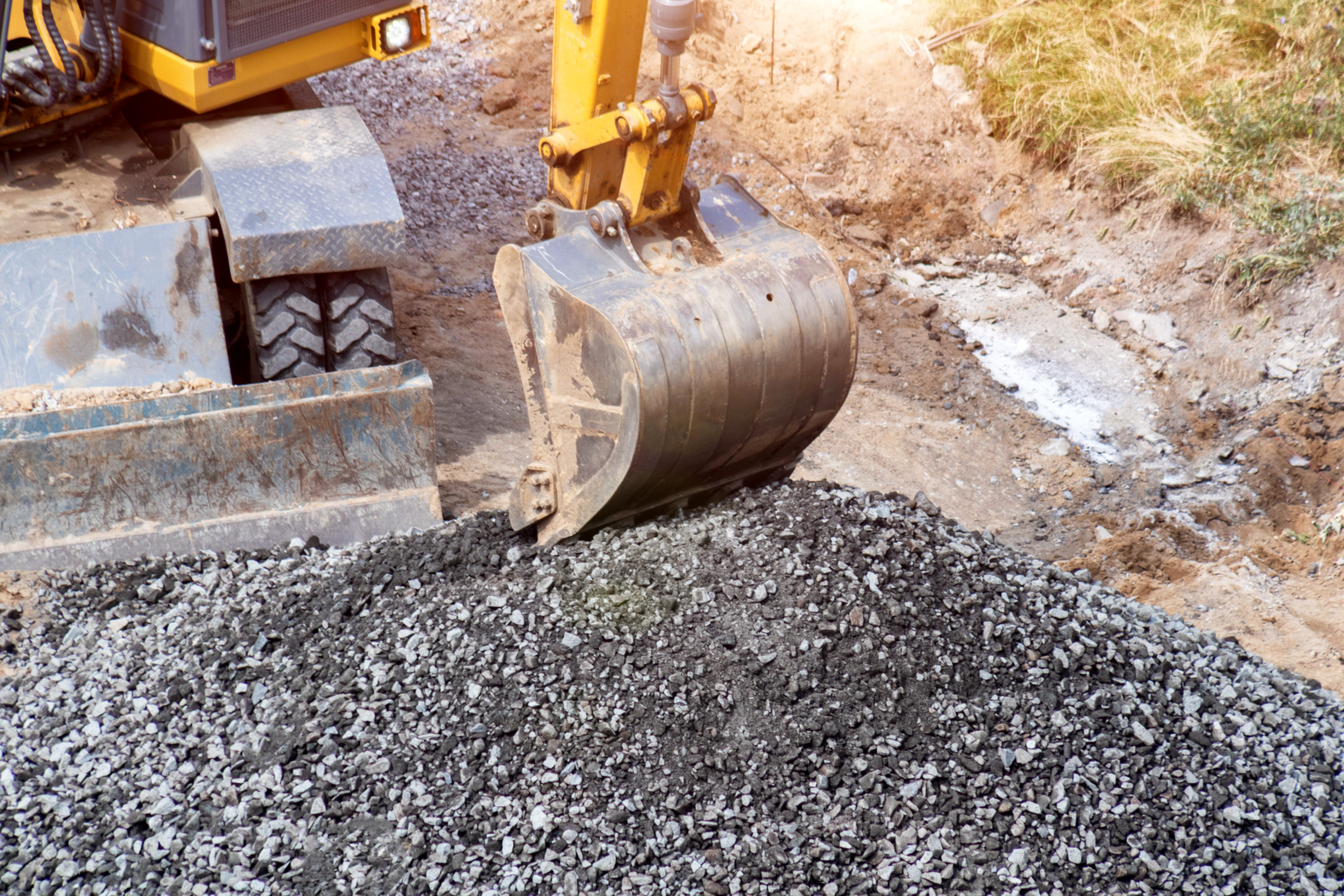
Crushed rock, gravel, and sand are made up of countless individual particles, and the size of those particles varies considerably from one product to the next. Some contain a broad mix of coarse stone and fine material; others are screened to hold the particle sizes within a much narrower range. That spread of sizes is aggregate gradation, and it decides how a material compacts, how it combines within a concrete mix, and how well it moves water through a drainage system.
What Is Aggregate Gradation?
Aggregate gradation is the distribution of particle sizes inside a batch of crushed rock, sand, or gravel. It’s measured, not estimated: a sample runs through a stack of sieves, and each screen holds back a portion of the material, producing a size profile for the whole load.
That profile shows how the material will pack. A load with a wide range of sizes packs tightly, because smaller particles settle into the gaps larger ones leave behind. A load weighted toward a single size, or missing several sizes on purpose, packs looser and leaves more open space once it’s compacted, mixed, or drained through. That same grading principle applies well beyond construction aggregate, covered in more detail in this look at industrial sand grades and applications.
How Does Gradation Affect a Base?
A base layer holds up because its particles interlock, not because any single stone is large. Crushed construction rock ships in that kind of controlled gradation, typically a one-inch or one-and-a-half-inch minus, letting larger stone lock together while finer material fills the spaces in between. That combination is what keeps a layer under a slab, a shed pad, or an RV pad holding a consistent depth once weight sits on it season after season.
The failure mode is easy to picture. Aggregate concentrated around a narrow band of sizes leaves void space between pieces, and voids invite movement. A well-graded base uses smaller particles to fill those openings, producing a denser compacted layer that resists settling and rutting under repeated load.
How Does Gradation Affect a Concrete Mix?
Aggregate makes up most of a concrete mix by volume, so the way those particles fit together sets how much paste is needed to fill the spaces between them. A well-graded combination of coarse and fine aggregate cuts unnecessary void space, giving the cement paste a tighter particle structure to bind and less empty room to fill.
The fine material matters as much as the coarse. Washed and graded concrete sand controls the fines that drive water demand and workability, so the mix holds steady from batch to batch. That particle distribution becomes part of the mix design alongside the water-cement ratio, cementitious content, and any admixtures specified for the pour.
How Does Gradation Affect Drainage?
Drainage calls for the opposite of a tightly packed base. An open, coarse gradation with few fine particles leaves larger gaps for water to move through instead of pooling against a foundation or a retaining wall. Pea gravel and drain-grade aggregate fit that role in a French drain or along a footing.
Dense concrete sand works against it. Built to stabilize a paver base, it holds water rather than passing it, which makes it the wrong choice for a trench meant to carry runoff away.
Which Gradation Fits the Job?
Interlock, concrete mix design, and drainage each depend on a different particle distribution, which is why gradation has to match the application rather than the other way around. A base needs a dense range of sizes that compacts tightly. Concrete relies on coarse and fine aggregate working together within the mix. Drainage rock needs open void space for water to move through freely.
Staker Parson screens and washes aggregate to controlled gradations for base, concrete, and drainage work, so the spec on paper matches what arrives on site. To match the right aggregate to a pour, base, or drainage project, request a quote.